[3D-4CH] MODULE 2: DATA CAPTURE
The courses within Module 2 are currently under development.
About:
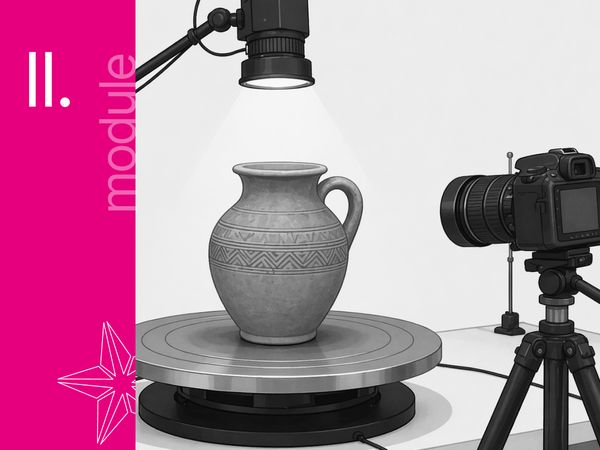
This learning module introduces participants to the full spectrum of 3D data capture approaches used in cultural heritage documentation. The opening section provides a broad, accessible overview of all major capture methods, ranging from photogrammetry and terrestrial laser scanning to structured light scanning, mobile mapping, and emerging hybrid techniques. This introductory component is designed to give learners a solid grounding in how each method works, what equipment is involved, and the types of heritage contexts where each approach is most effective.
Following this foundation, subsequent modules dive deeper into individual methodologies and technologies. Each specialised module focuses on a single technique, guiding participants through its workflow, data characteristics, practical considerations, and common challenges. This structure allows learners to build both breadth and depth: first understanding the landscape of 3D capture options, then gaining expertise in specific tools and approaches.
Throughout the programme, a strong emphasis is placed on developing the ability to critically evaluate which method is most suitable for a given documentation task. Participants will learn to assess key criteria such as scale (from artefacts to landscapes), resolution requirements, environmental conditions, material properties, project goals, and the skill levels needed to achieve reliable results. Through video tutorials, practical exercises, and real world examples, learners will build confidence in selecting and applying the right technique for the right context.
By the end of the module, participants will be equipped to make informed decisions and contribute effectively to high quality 3D recording within cultural heritage settings.
Learning outcomes:
- Introduction to the range of different 3D digitisation methodologies
- Deep understanding of the specific different 3D digitisation methodologies including: capture technologies, accuracy and resolutions, data outputs
- The ability to critically evaluate each technology and decide on the methodology according to the requirements of a specific project, including costs, environment, access, expertise
- Apply best-practice standards and guidelines.
- Explore the output options for specific capture methodologies
- Process raw data and primary produce 3D digital data sets which can be used for replicas of the physical world for the chosen capture methodology.
Target audience: Practitioners, field archaeologists/surveyors, museum documentation staff, metrologists.
This is not a single course, but a broader module composed of multiple interrelated courses, forming a flexible learning framework.