[3D-4CH] MODULE 3: DATA PROCESSING
The courses within Module 3 are currently under development.
About:
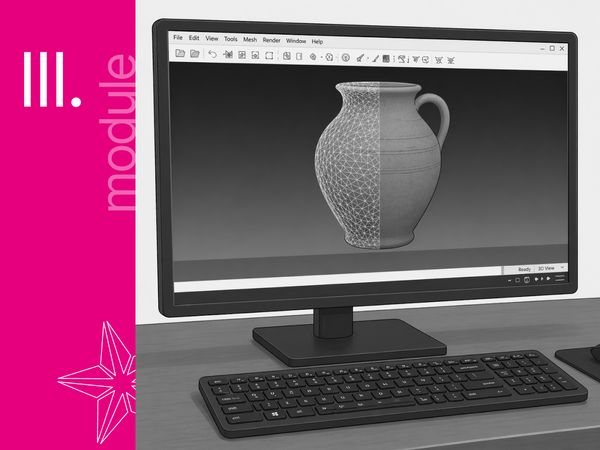
This module provides a comprehensive introduction to 3D data processing techniques essential for cultural heritage preservation. Designed for practitioners and researchers, it covers the full pipeline from raw data capture to final data management, with hands-on training in processing workflows for a range of technologies including photogrammetry (SfM), terrestrial laser scanning (TLS), UAV-based systems, SLAM and hybrid approaches. Participants will gain practical experience in pre-processing, alignment, 3D model generation and data refinement using industry-standard software tools.
Furthermore, it advances in more technical aspects, such as data fusion from multiple sources, like the integration of multispectral imagery, georeferencing and coordinate geometry (COGO). Also, a brief introduction is provided on managing processed data, including file formats, metadata standards, storage solutions and long-term preservation strategies aligned with FAIR principles. Emphasis is placed on achieving high-quality, accurate and interoperable 3D models suitable for documentation, analysis and digital dissemination.
This module equips participants with the essential skills to effectively process and curate 3D data in a cultural heritage context.
Learning outcomes:
- Execute end-to-end workflows for processing diverse 3D data types.
- Solve heritage-specific processing challenges, by following the best practices (e.g., occlusions, reflective surfaces).
- Produce publication-ready models and metadata.
Target audience: Practitioners, field archaeologists, metrologists.
This is not a single course, but a broader module composed of multiple interrelated courses, forming a flexible learning framework.